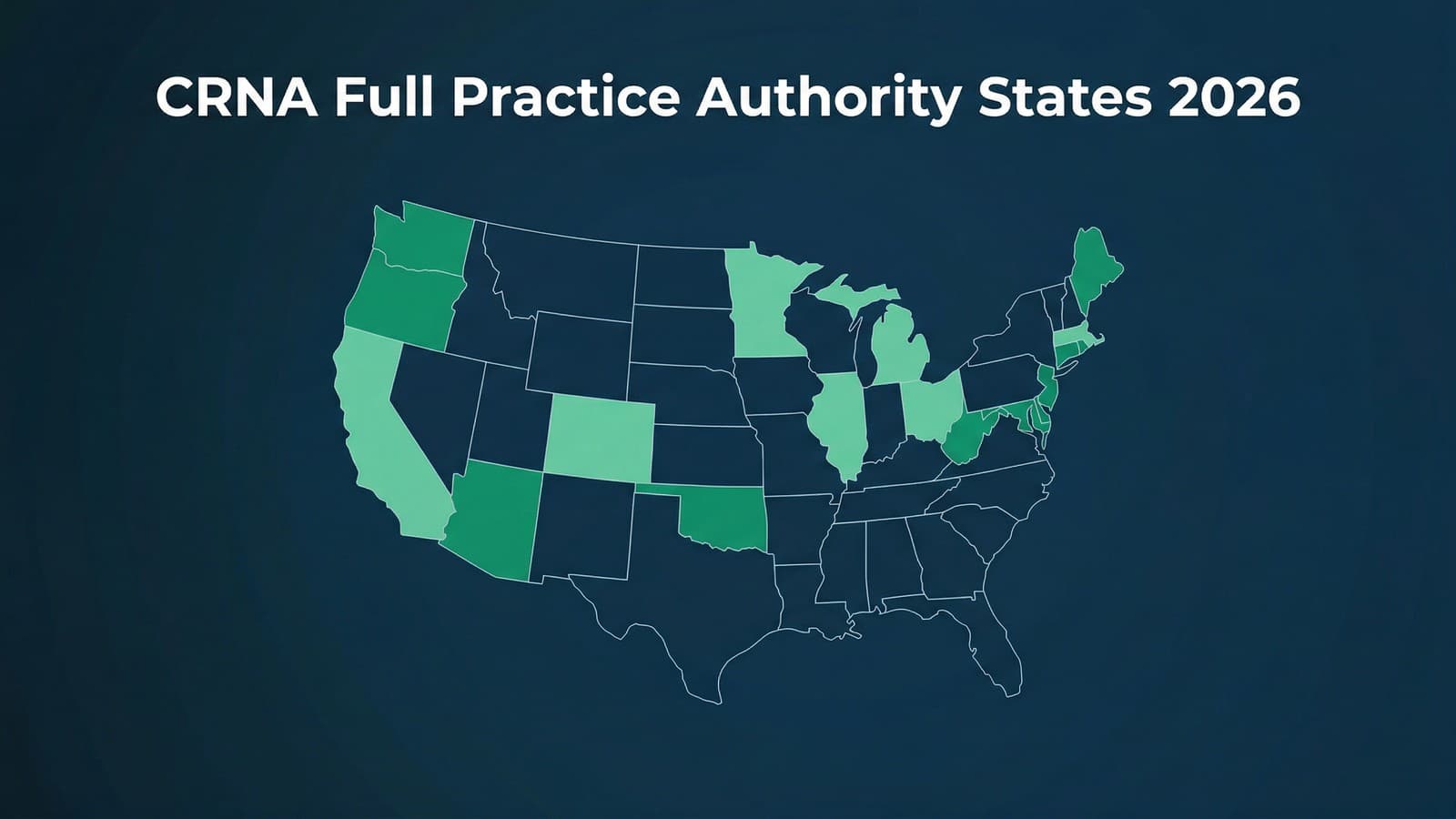
Short answer. RxRooster’s October 2026 review places 15 states and Washington, D.C., in its full-practice category for CRNA anesthesia services. AANA separately records a federal Medicare supervision opt-out for 27 states, D.C. and Guam. A CRNA evaluating a job needs both answers and the privileges granted by the facility.
Which states meet RxRooster’s full-practice definition?
We use “full” for jurisdictions where the federal exemption and state anesthesia rules permit practice without a standing physician-supervision or collaboration requirement. We use “partial” for setting-dependent, experience-dependent or other conditional arrangements. “Restricted” includes required direction, supervision or collaboration. These are RxRooster’s working definitions for comparing jobs. A state’s general nurse practitioner designation can answer a different question.
| Category | Jurisdictions |
|---|---|
| Full (16) | Alaska, California, Colorado, Delaware, Idaho, Iowa, Kentucky, Massachusetts, Minnesota, Montana, New Hampshire, New Mexico, North Dakota, Oregon, Washington, Washington, D.C. |
| Partial (10) | Arkansas, Hawaii, Kansas, Michigan, Nebraska, South Dakota, Utah, Vermont, Wisconsin, Wyoming |
| Restricted (25) | Alabama, Arizona, Connecticut, Florida, Georgia, Illinois, Indiana, Louisiana, Maine, Maryland, Mississippi, Missouri, Nevada, New Jersey, New York, North Carolina, Ohio, Oklahoma, Pennsylvania, Rhode Island, South Carolina, Tennessee, Texas, Virginia, West Virginia |
Which states opted out of federal Medicare supervision?
AANA’s September 2026 register lists Alaska, Arizona, Arkansas, California, Colorado, Delaware, Idaho, Iowa, Kansas, Kentucky, Massachusetts, Michigan, Minnesota, Montana, Nebraska, New Hampshire, New Mexico, North Dakota, Ohio, Oklahoma, Oregon, South Dakota, Utah, Vermont, Washington, Wisconsin and Wyoming. It also lists Washington, D.C., and Guam. Utah and Wyoming have facility-specific exemptions. D.C.’s exemption covers hospitals. AANA’s dated register and facility exceptions.
The federal hospital rule sets a supervision condition and describes how a governor requests an exemption. A state opt-out changes that federal condition for the covered facilities. State nursing law and a hospital’s own privileges still govern what a particular CRNA can do there. 42 CFR § 482.52(a) and (c).
Why Ohio appears on one list and in a different category on the other
Ohio opted out of federal supervision in July 2026. Ohio law still describes CRNA practice in collaboration with a physician, podiatrist or dentist and addresses requests for anesthesia services and facility privileges. A recruiter’s statement that “Ohio opted out” answers only the federal question. Ohio Revised Code § 4723.43(D). AANA opt-out chronology.
What to verify before accepting an assignment
- Ask which facility and care setting the contract covers. A rural-hospital exemption may have a narrower scope than the state name suggests.
- Get the anesthesia department’s description of the coverage model, who must be available and which procedures your privileges would cover.
- Check the current state statute or board rule, particularly when changing settings or taking call at a second location.
- Compare base pay, call, paid time and scheduled hours in the offer itself. A state’s classification alone cannot establish what the job pays or how long credentialing will take.
Federal chronology and Ohio law checked November 25, 2026. The 51-jurisdiction grouping reflects RxRooster’s October 2026 review.