TLDR
Rural anesthesia coverage in 2026 is a workforce-distribution problem, not a workforce-supply problem. More than 1,300 critical access hospitals depend on a small bench of CRNAs, and the math says rural facilities pay top-quartile rates. New Mexico, Nebraska, North Dakota, and Wyoming are paying $208 to $271 an hour for CRNAs willing to drive past the suburbs. The states that have already given CRNAs full practice authority are the same states keeping their rural ORs running.
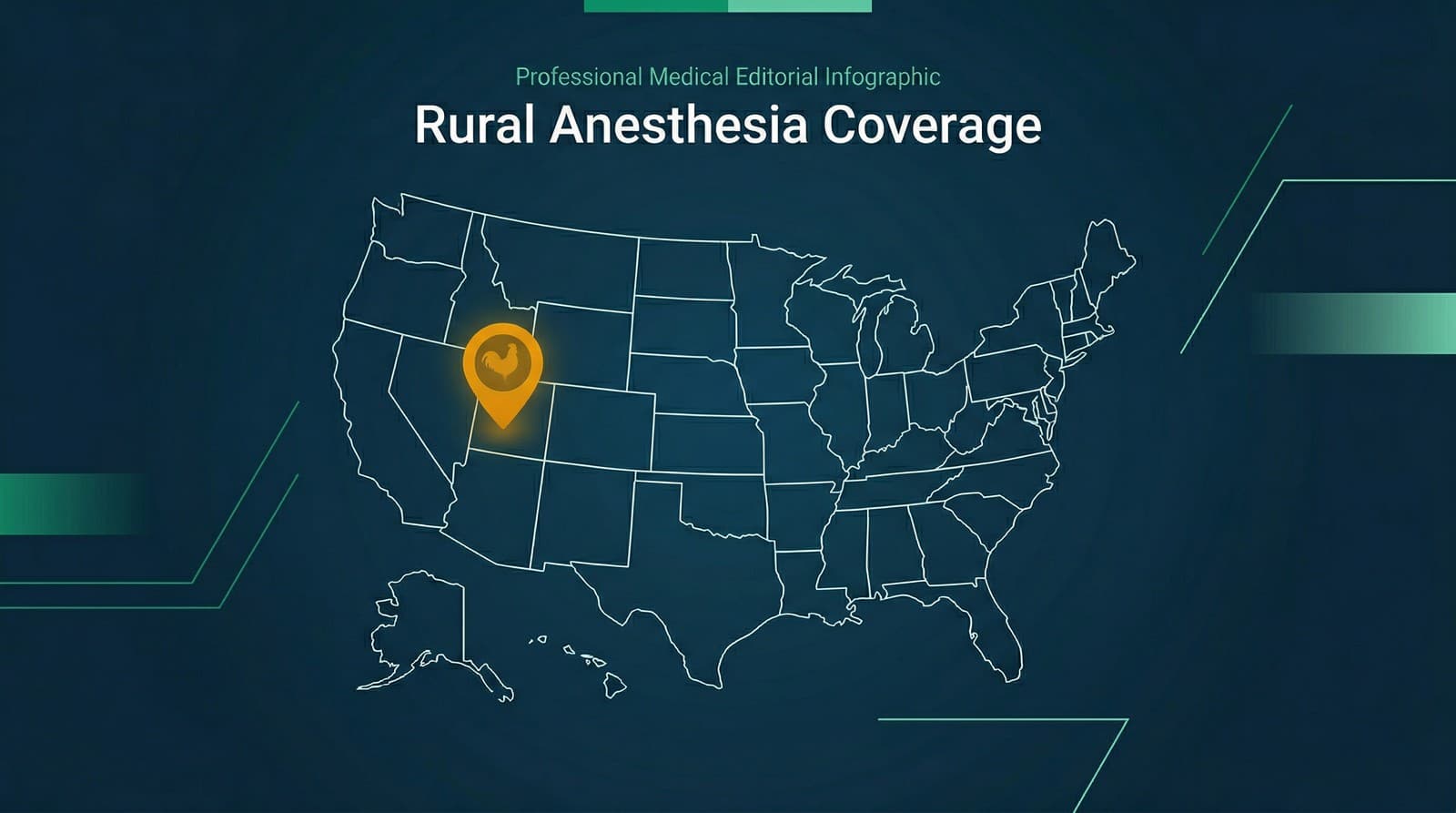
Rural anesthesia coverage in the United States runs on roughly 67,700 practicing CRNAs and a regulatory map that finally caught up with the geography. Thirty-one states plus the District of Columbia have granted CRNAs full practice authority. Two more, Utah and Wyoming, have opted out of CMS supervision specifically for rural and critical access hospitals. The rural rate map is the workforce-policy map.
At 4:50 a.m. on a Wednesday in Buffalo, Wyoming, the only CRNA at a fifteen-bed critical access hospital starts her car. Her first case is a hip pinning at 6:30. The nearest anesthesiologist is in Sheridan, thirty-three miles north on I-90, and is not coming. She has practiced independently for seventeen years. The state opted out of CMS supervision for rural and critical access hospitals before she finished her training. Her hospital pays $208 an hour, and the annual figure across her on-call weeks reaches $432,640 because she works the call schedule that an urban CRNA would not.
That scene is not a curiosity. It is the operating model for more than 1,300 critical access hospitals across the United States, per the Rural Health Information Hub. These are the small-bed facilities that make up the largest single category of rural inpatient care, and the anesthesia coverage that keeps their ORs scrubbed comes almost entirely from CRNAs. The AANA projects a 12,500-CRNA shortage by 2033. Most of the slack will come out of rural America first.

Where Rural Anesthesia Coverage Pays the Most
The hourly rate map for rural anesthesia coverage looks nothing like the population-weighted map. New Mexico pays $271 an hour. Nebraska pays $267. North Dakota pays $263. South Dakota pays $242 with no state income tax. Maine pays $234. Iowa pays $233. Vermont pays $230. Montana, Idaho, and Wyoming all pay over $208 with full or rural-specific practice authority.
Every single one of those states is on the FPA list at backend/docs/business/credentialling/state_practice_authority.md. The correlation is not a coincidence. States that grant CRNAs autonomous practice authority can recruit CRNAs into single-coverage assignments where physician supervision is logistically impossible. States that still require supervision cannot, which puts a ceiling on what their rural facilities can pay because the rural facilities cannot keep an anesthesiologist on the schedule for what the case volume justifies.
Wyoming is the cleanest case. The state opted out of CMS supervision specifically for rural and critical access hospitals, which is the partial-opt-out arrangement noted in our state map. The hourly figure looks moderate at $208. The annual figure of $432,640 is the highest in the country. The reason is the call structure: rural CRNAs work the schedule that produces those hours because the alternative is an empty OR.
Why the Rural Coverage Problem Is Not a Supply Problem
The instinct is to call this a CRNA shortage. It is not, at least not at the headline workforce level. The BLS counts 67,700 practicing CRNAs in the United States as of May 2025. The AANA tracks 8,500 SRNAs enrolled in accredited programs. New CRNAs enter the workforce on a rolling basis. The headline workforce is growing, not shrinking.
The constraint is geographic distribution. Most CRNAs enter the workforce in or near the academic medical centers where they trained. Recruiting them out to a critical access hospital sixty or one hundred miles from the nearest interstate exchange is hard for three reasons that compound. First, the rural facility cannot meet the candidate at a recruiting fair the way a level-one trauma center can. Second, the rural facility's listing rarely shows the rate, so a candidate weighing a $271-an-hour New Mexico opening against an undisclosed Iowa opening defaults to the one with the visible number. Third, even when the candidate says yes, credentialing into a rural hospital still runs the industry-baseline 90 days because most rural credentialing offices have not adopted the automation that academic systems have.
Sixty-seven percent of ambulatory surgery centers cite anesthesia coverage as their number-one operational challenge, per Anesthesia Experts. That number is even higher in rural systems where a single open position closes a single OR. The 30% of anesthesiologists projected to retire by 2033, per Becker's, will accelerate the shift in coverage burden toward CRNAs and toward the states that have built the regulatory framework to support solo coverage.

What Closes the Rural Anesthesia Gap
Three changes move the rural coverage curve, and only one of them involves training more CRNAs.
The first is rate visibility. Rural facilities that publish their rate up front fill positions faster than facilities that wait for the recruiter conversation. A candidate evaluating a Sidney, Nebraska opening at $267 an hour against a Sioux Falls, South Dakota opening at $242 with no state income tax can do that math in twenty seconds. A candidate evaluating two undisclosed rates does no math at all and ignores both. Rate transparency is not a marketing claim. It is a recruiting prerequisite for facilities that have to compete from a geographic disadvantage.
The second is credentialing speed. Rural facilities lose more candidates to a 90-day credentialing pipeline than to rate competition. The same six primary sources that work for an urban hospital, NPPES, NBCRNA, state licensing via Nursys, DEA, OIG LEIE, and SAM.gov, work for a critical access hospital. The barrier is not data availability. It is whether the rural medical staff office has access to the automation that connects to those sources. Closing the credentialing gap from 90 days to 14 days lets a rural facility hire a CRNA who would otherwise take a faster offer from a metro hospital.
The third is the regulatory floor. Six states still require physician supervision of CRNAs, which forecloses single-coverage rural assignments at most of their hospitals. The rural coverage problem in those states is a state-policy problem, not a workforce problem. The data from the 31 FPA states is the empirical case for opt-out. None of the states that have opted out have reversed the decision. Massachusetts opted out in June 2024. Colorado opted out in October 2023. Both were urban-driven decisions that immediately benefited rural hospitals.
Related resources: CRNA Full Practice Authority States in 2026, The Hidden Cost of Anesthesia Staffing Delays, Why We Automated CRNA Credentialing, CRNA Salary by State 2026, The 12,500 Problem, Wyoming CRNA salary detail, New Mexico CRNA salary detail.
The Takeaway
Rural anesthesia coverage in 2026 is held together by CRNAs working in the states that gave them the legal authority to practice independently. The hourly rates are the highest in the country in those states for a reason. Solving the rural coverage gap is faster credentialing, visible rates, and the regulatory framework that already works in 31 of 50 states.
See the data on RxRooster. Every rural rate, every state, every credential verified before the first call.
Frequently Asked Questions
Why do rural CRNAs earn more than urban CRNAs?
Rural CRNAs earn more because rural facilities are competing with urban facilities for a workforce concentrated near urban training programs, and they pay a geographic premium plus a call-burden premium for solo coverage. New Mexico, Nebraska, North Dakota, and South Dakota all pay above $240 an hour, and Wyoming reaches $432,640 annually because of call-heavy schedules.
How many critical access hospitals depend on CRNAs for anesthesia?
More than 1,300 critical access hospitals across the United States depend on CRNAs for the majority of their anesthesia coverage, per the Rural Health Information Hub. In most of these facilities, a CRNA is either the sole anesthesia provider or part of a small bench of two to three.
Which states allow CRNAs to practice independently in rural hospitals?
Thirty-one states plus the District of Columbia grant CRNAs full practice authority statewide. Two additional states, Utah and Wyoming, have opted out of CMS supervision specifically for rural and critical access hospitals. The full list is maintained at backend/docs/business/credentialling/state_practice_authority.md and updated as new opt-outs occur.
Is the rural anesthesia shortage a workforce-supply problem?
The rural anesthesia shortage is a workforce-distribution problem rather than a workforce-supply problem. The BLS counts 67,700 practicing CRNAs and 8,500 SRNAs in training, with the workforce growing on a rolling basis. The constraint is geographic distribution, credentialing speed, and the supervision laws of the six remaining non-opt-out states.
What changes would close the rural anesthesia coverage gap fastest?
Three changes close the rural anesthesia coverage gap fastest: rate transparency at the listing level, automated credentialing that compresses the 90-day baseline to under three weeks, and CMS opt-out adoption in the remaining supervision states. Together they shift the recruiting math in favor of the rural facility.