TLDR
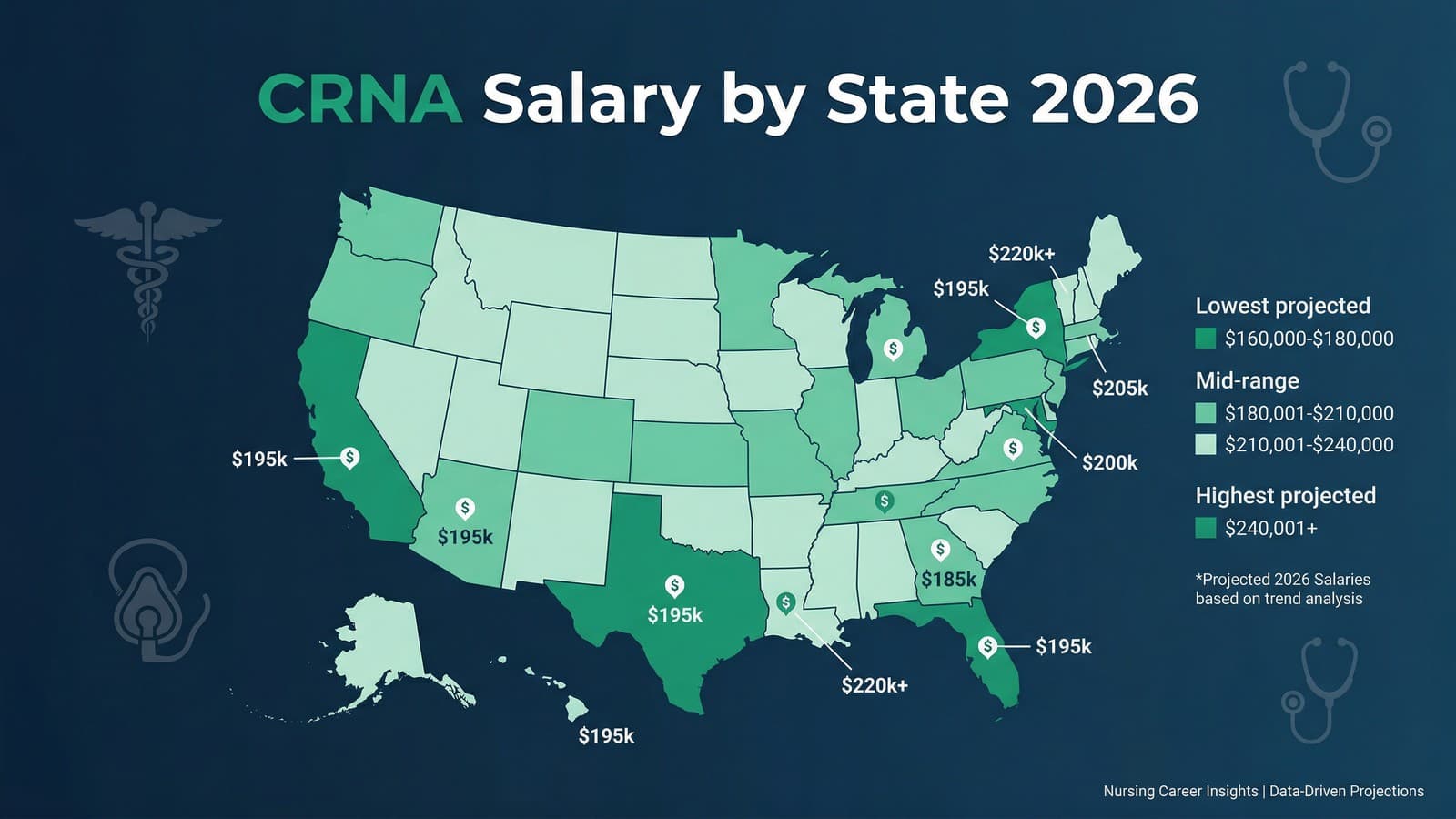
CRNA salary by state ranges from under $225,000 in Alabama and Florida to over $430,000 in Wyoming and $383,000 in California based on RxRooster aggregated data. The national average is $231,700 (BLS, 2024). Full practice authority status, no-income-tax states, locum versus permanent employment, and metro versus rural settings create salary differences that can exceed $200,000 for CRNAs with identical credentials.
CRNA salary by state varies by more than $200,000 annually between the lowest- and highest-paying states. The Bureau of Labor Statistics reports a national average CRNA salary of $231,700 per year (2024 data). But national averages obscure enormous regional differences that determine whether a CRNA earns $190 per hour in Florida or $271 per hour in New Mexico.
A CRNA in Tuscaloosa, Alabama, works three 12-hour shifts per week at a community hospital. She earns $194 per hour. Good work. Stable schedule. Ten-minute commute. Twelve hundred miles west, a CRNA with the same NBCRNA certification, the same years of experience, and the same case mix works at a rural critical access hospital outside Roswell, New Mexico. His rate: $271 per hour. The difference over a full year: more than $160,000. He did not negotiate harder or train longer. He chose a different state.
The 67,700 CRNAs working in the United States (BLS, May 2025) practice across 50 states with different tax structures, different practice authority laws, different costs of living, and different levels of demand. This guide breaks down CRNA compensation by state using RxRooster aggregated data, cross-referenced with BLS figures, to show where the money is and why.

Highest-Paying States for CRNAs in 2026
The top-paying states for CRNAs combine high demand, rural coverage needs, and favorable practice environments. The following rankings use RxRooster aggregated compensation data, which includes permanent salary, locum rates, and contract positions from across the market.
Wyoming leads at $432,640 average annual compensation ($208/hr). The state's small population, vast distances, and critical access hospital network create persistent demand for anesthesia providers. Wyoming grants partial FPA for rural facilities, has no state income tax, and offers the kind of premium rates that come with geographic isolation.
California follows at $383,090 ($225/hr). The state's high cost of living partially explains the number, but California CRNAs also benefit from full practice authority, strong union representation in some hospital systems, and a surgical volume that keeps demand constant across the state's 400+ hospitals.
New Mexico ranks third at $353,200 ($271/hr). This is the highest hourly rate in the country. New Mexico grants full practice authority, has significant rural and tribal healthcare needs, and struggles to attract providers from more populated states. The result: locum and permanent rates that compensate for the state's lower cost of living with some of the most competitive per-hour compensation in the profession.
Rounding out the top ten: Oklahoma ($323,509), Indiana ($318,038), Arizona ($316,169), Oregon ($315,392), Pennsylvania ($311,819), Nevada ($309,500), and Idaho ($306,167). Several of these states share common traits: full practice authority, rural coverage gaps, and growing surgical volume.
Lowest-Paying States for CRNAs
Wisconsin averages $201,186 per year despite offering $241/hr in hourly rate data, which reflects a market where most CRNA positions are part-time or per-diem rather than full-time salaried. Washington, D.C. averages $220,000. Florida, despite its massive healthcare market and no state income tax, averages $224,038 ($190/hr). Alabama sits at $225,283 ($194/hr). Tennessee rounds out the bottom five at $240,739 ($188/hr).
The pattern in low-paying states: physician supervision requirements (Florida, Alabama, Tennessee all require supervision), saturation of CRNA programs in the region, or a market structure that favors physician anesthesiologist-led care teams over independent CRNA practice.
The No-Income-Tax Advantage
Nine states charge no state income tax on earned income: Alaska, Florida, Nevada, New Hampshire, South Dakota, Tennessee, Texas, Washington, and Wyoming. For CRNAs earning between $200,000 and $400,000, the absence of state income tax can add $10,000 to $30,000 to take-home pay compared to a state with a 5% to 10% marginal rate.
The tax advantage compounds differently across these states. Wyoming combines no income tax with the highest average CRNA compensation ($432,640). A CRNA in Wyoming keeps more of a bigger number. Washington state offers no income tax with $290,129 average compensation. Texas pairs no income tax with $284,445 average compensation and a massive healthcare market (more than 600 hospitals).
Alaska deserves separate attention: $303,667 average compensation, no income tax, and a market where remote facilities pay premium rates for providers willing to travel. A locum CRNA working bush Alaska assignments can earn $250+ per hour with housing and travel included. The trade-off is geographic isolation that most providers experience for 13-week stints, not permanent relocation.
Florida is the exception to the no-tax advantage. Despite no state income tax, Florida's average CRNA compensation ($224,038, $190/hr) is among the lowest in the country. High provider supply, physician supervision requirements, and a cost of living that has risen sharply since 2020 erode the tax benefit. A CRNA earning $224,000 in Florida with no state tax keeps roughly the same take-home as a CRNA earning $250,000 in a state with a 5% income tax and lower housing costs.

Cost of Living Changes the Math
A $383,090 salary in California and a $323,509 salary in Oklahoma do not produce the same lifestyle. California's cost of living, particularly housing in the Bay Area and Los Angeles metro, consumes a larger share of gross income than Oklahoma's. The CRNA who earns $60,000 more in California may net less disposable income than the CRNA in Tulsa after rent, taxes, and daily expenses.
The highest cost-of-living-adjusted CRNA salaries cluster in states with three traits: above-average compensation, below-average cost of living, and no state income tax. Wyoming checks all three boxes: $432,640 average compensation, low cost of living, no income tax. South Dakota offers $250,250 with low cost of living and no income tax. Nevada delivers $309,500 with no income tax and moderate cost of living.
The states where CRNAs lose the most to cost of living: California (very high COL, high state taxes despite high gross pay), Hawaii ($280,000 average but very high COL that erodes roughly 30% of the apparent premium over mainland states), and Washington, D.C. ($220,000 average in one of the most expensive housing markets in the country).
Iowa stands out as a hidden advantage. At $299,631 average compensation ($233/hr), FPA status, and below-average cost of living, Iowa CRNAs retain a higher percentage of their gross income than CRNAs in most coastal states earning larger gross numbers. The same logic applies to Nebraska ($283,491, $267/hr, FPA, low COL), Kansas ($291,761, $215/hr, FPA, low COL), and North Dakota ($303,333, $263/hr, FPA, low COL). These Midwest FPA states rarely appear on "top-paying" lists because their gross numbers are not the highest. But the net numbers tell a different story.
Best Overall Value: Where Salary, Taxes, FPA, and Cost of Living Converge
If you optimize for take-home pay, autonomy, and purchasing power simultaneously, a handful of states rise above the rest.
Wyoming: $432,640, no income tax, FPA (partial, rural facilities), low cost of living. The highest gross and one of the highest net compensation levels in the country. The trade-off: Wyoming's population (576,000) means a small market and rural-dominant practice settings.
South Dakota: $250,250, no income tax, FPA, low cost of living. Moderate gross compensation, but the combination of zero tax and low COL produces strong take-home numbers. Sioux Falls and Rapid City provide enough urban infrastructure to avoid the isolation factor that limits some rural states.
Nevada: $309,500, no income tax, FPA, moderate cost of living. Las Vegas and Reno offer urban practice settings with no state tax. FPA status means independent practice is available. The combination of compensation, autonomy, and tax efficiency makes Nevada one of the strongest overall-value states for CRNAs.
Iowa: $299,631, FPA, low cost of living. Iowa has state income tax, but the combination of a $299,631 average (above the $231,700 national average), full practice authority, and low housing costs produces net compensation that competes with many no-tax states.
Washington: $290,129, no income tax, FPA, high cost of living. Seattle's cost of living is steep, but the eastern half of the state offers lower COL with the same tax and FPA advantages. A CRNA in Spokane or Yakima benefits from Washington's tax structure without Seattle's housing market.
What New Graduates and SRNAs Should Expect
The 8,500 SRNAs enrolled in accredited programs (AANA) graduate into a market with wide salary variance and a 35% employment growth projection through 2034 (BLS). New graduate CRNA salaries typically start 10% to 15% below state averages. A new graduate in California might start at $330,000 to $345,000 rather than the $383,090 average. A new graduate in Alabama might start at $195,000 to $205,000.
The gap closes within two to three years as CRNAs build case experience and facility relationships. For new graduates choosing a first position, three factors matter more than starting salary. First: FPA status. New graduates who begin in FPA states build independent practice history from day one. That history becomes a career asset when pursuing locum work or direct facility contracts later. Second: case variety. A rural critical access hospital exposes new graduates to a broader case mix than a specialized urban ambulatory surgery center. Third: credentialing speed. States with simpler credentialing requirements (typically FPA states) allow new graduates to start working faster after passing boards.
The 12,500-position CRNA shortage projected by 2033 means new graduates enter a market with strong demand. The states that offer the best combination of compensation, autonomy, and career development will attract the most new graduates. The data in this guide gives SRNAs the numbers to make that decision before graduation.
How Full Practice Authority Affects CRNA Pay
The relationship between FPA and compensation is real but not uniform. Among the top 10 paying states, several grant full or partial practice authority: Oregon ($315,392, FPA), Idaho ($306,167, FPA), Nevada ($309,500, FPA). The complete FPA state guide lists all 31 states and D.C. with full opt-out status.
FPA states pay more on average because they allow facilities to staff operating rooms with CRNAs as sole anesthesia providers. A rural surgery center in Oregon does not need to hire a supervising anesthesiologist at $450,000 to employ three CRNAs. The savings redistribute as higher CRNA rates. In supervision-required states, the facility pays both the physician and the CRNAs, which caps the compensation available for each role.
The correlation is strongest in rural markets. A sole-provider CRNA at a critical access hospital in Montana ($289,000 average, FPA state) operates independently across all case types. That autonomy commands premium pay. The same CRNA at an urban academic medical center in Ohio ($248,803, supervision required) works within a care team model where the physician sets the clinical parameters. Different scope. Different value to the facility. Different rate.
Locum Versus Permanent CRNA Salary
Locum CRNAs earn an average of $200 per hour (Anesthesia On Call), annualizing to approximately $416,000 for full-time locum work. Top locum earners reach $400,000 to $500,000 per year (industry locum data). The premium over permanent positions reflects the instability, travel requirements, and benefits gap that locum work entails.
The locum premium varies by state. In high-paying permanent markets like California and Wyoming, locum rates run $225 to $275 per hour. In lower-paying states like Alabama and Tennessee, locum rates jump to $220+ because facilities struggling to fill permanent positions pay premiums for temporary coverage. A CRNA who would earn $194 per hour as a permanent employee in Alabama can earn $240 per hour as a locum in the same state. The difference: $95,680 per year for identical work.
The full breakdown of CRNA locum rates in 2026 covers W-2 versus 1099 considerations, agency rate spreads, and the three numbers every locum CRNA should know before accepting a contract.
W-2 Versus 1099: The Number Behind the Number
Comparing a W-2 salary to a 1099 contract rate without adjusting for taxes, benefits, and expenses produces a misleading comparison. A W-2 CRNA earning $280,000 receives employer-paid health insurance ($15,000 to $25,000 value), retirement contributions (3% to 6% match), malpractice coverage, paid time off, and the employer's half of FICA taxes. A 1099 CRNA earning $280,000 pays all of those costs personally.
The standard conversion: multiply a W-2 salary by 1.25 to 1.30 to find its 1099 equivalent. A $280,000 W-2 position equals roughly $350,000 to $364,000 in 1099 income to achieve the same net compensation. A locum CRNA earning $200 per hour ($416,000 annualized) on a 1099 basis achieves a W-2-equivalent income of approximately $320,000 to $333,000 after self-employment taxes, individual health insurance, and retirement funding.
State taxes interact with this calculation. A 1099 CRNA in Texas (no income tax) keeps a larger share of gross income than a 1099 CRNA in California (13.3% top marginal rate). The state salary averages in this guide blend W-2 and 1099 positions. The locum rates guide breaks down the W-2 versus 1099 math in detail for CRNAs evaluating contract work.
Metro Versus Rural CRNA Salary
Rural facilities consistently pay higher per-hour rates than their urban counterparts. The reasons are structural: smaller candidate pools, geographic isolation, and the critical access hospital designation that requires 24/7 anesthesia coverage. A CRNA willing to work at a 25-bed hospital in rural Idaho earns more per hour than a CRNA at a 500-bed urban medical center in Boise. The trade-off is case variety, call frequency, and professional isolation.
The metro-rural gap is widest in states with large geographic spread: Texas, Montana, Alaska, New Mexico, Oregon. A CRNA in Portland earns differently than a CRNA in Burns, Oregon (population 2,800). The state average ($315,392) blends both markets. Facility-level data on RxRooster shows the actual rate at each location.
How to Use This Data
State averages are starting points, not conclusions. Three steps turn this data into a career decision.
First: compare your current compensation to the state average and the top-paying states in your region. If you earn less than your state's average, you may be underpaid. If your state's average trails neighboring states by $30,000 or more, a geographic move may carry a compensation premium worth the transition cost.
Second: factor in taxes. A $300,000 salary in Texas (no income tax) and a $300,000 salary in California (13.3% top marginal rate) produce different take-home numbers. RxRooster's state salary pages include tax context for each state.
Third: consider practice authority. The FPA state guide shows which states grant independent practice. FPA states tend to offer higher compensation, simpler credentialing, and more diverse practice settings. A move to an FPA state is not just a salary decision. It is a scope-of-practice decision.
Fourth: look at facility-level data, not just state averages. The difference between the highest- and lowest-paying facility in a single state can exceed $80,000 per year. State averages smooth over gaps that matter enormously to an individual CRNA. Anonymous browsing on RxRooster lets you see facility-level rates without creating an account or alerting your current employer.
Related resources: California CRNA salary data, Wyoming CRNA salary, New Mexico CRNA salary, the 12,500 CRNA shortage, Credential Vault guide, CRNA jobs in Texas.
The Takeaway
CRNA salary is not a single number. It is a function of state, setting, tax structure, practice authority, and employment model. The CRNAs who earn the most treat compensation as a data problem. They know the state averages. They understand the tax implications. They evaluate FPA status alongside salary. They compare facility-level rates before accepting any position. The data exists. The question is whether you use it.
See the data on RxRooster. Every rate, every state, every credential verified before the first call.
Frequently Asked Questions
What is the average CRNA salary in the United States?
The national average CRNA salary is $231,700 per year according to BLS 2024 data. RxRooster aggregated data shows a wider range when factoring in locum, contract, and part-time positions, with state averages ranging from under $225,000 to over $430,000.
Which state pays CRNAs the most?
Wyoming leads with average annual CRNA compensation of $432,640 based on RxRooster aggregated data. California ($383,090) and New Mexico ($353,200) rank second and third. New Mexico has the highest average hourly rate at $271 per hour.
Do CRNAs earn more in states with no income tax?
Nine states have no state income tax. Among them, Wyoming ($432,640), Alaska ($303,667), Washington ($290,129), and Texas ($284,445) offer strong CRNA compensation. Florida ($224,038) is the notable exception: no income tax but below-average CRNA pay due to high provider supply and supervision requirements.
How much more do locum CRNAs earn than permanent CRNAs?
Locum CRNAs average $200 per hour ($416,000 annualized) compared to the $231,700 national average for permanent positions. Top locum earners reach $400,000 to $500,000 per year. The premium compensates for travel, benefits gaps, and contract instability.
Does full practice authority affect CRNA salary?
FPA states tend to pay higher CRNA salaries, particularly in rural settings where CRNAs serve as sole anesthesia providers. The correlation is strongest in states with significant rural healthcare needs like Oregon ($315,392), Idaho ($306,167), and Montana ($289,000), all of which grant full practice authority.
What is the best state for CRNAs considering salary, taxes, and cost of living?
Wyoming, Nevada, South Dakota, and Washington offer strong combinations of above-average compensation, no state income tax, and full practice authority. Wyoming leads with $432,640 average compensation and no income tax. Iowa and Nebraska offer high compensation with FPA and low cost of living, despite having state income tax. The best state depends on whether you prioritize gross pay, take-home pay, practice autonomy, or lifestyle factors.
How much do new graduate CRNAs earn?
New graduate CRNA salaries typically start 10% to 15% below state averages, with the gap closing within two to three years. A new graduate in California might start around $330,000 to $345,000 versus the $383,090 state average. BLS projects 35% CRNA employment growth through 2034, which means new graduates enter a market with strong demand across nearly all states.