TLDR
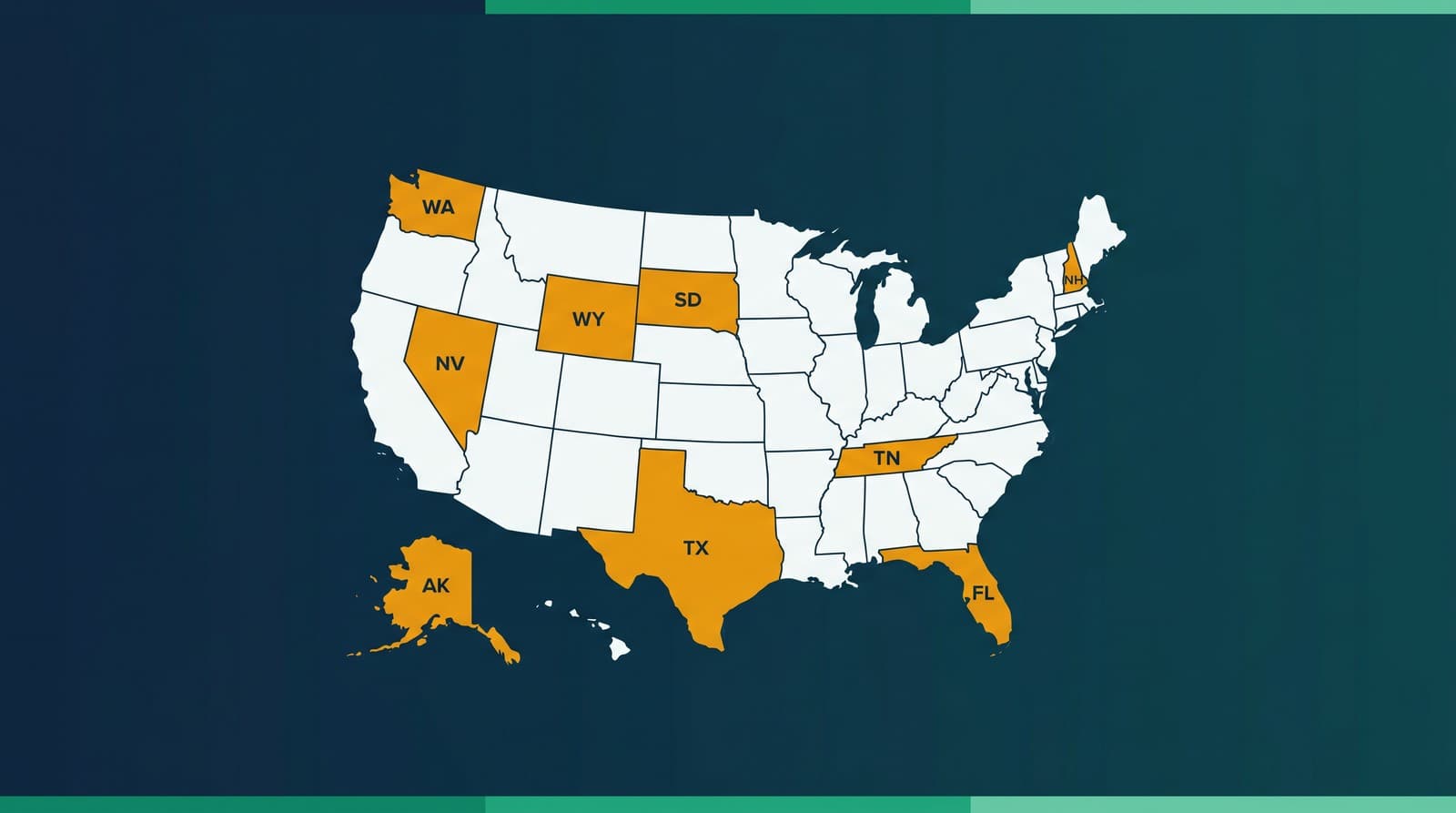
Nine U.S. states charge zero state income tax: Alaska, Florida, Nevada, New Hampshire, South Dakota, Tennessee, Texas, Washington, and Wyoming. For CRNAs earning $240,000 to $430,000 annually, the tax savings range from $21,000 to $40,000 per year compared to a high-tax state like California. Six of the nine also grant full practice authority. Wyoming leads with the highest annual compensation ($432,640) and no income tax, but its hourly rate ($208) and high call burden tell a different story than the annual figure suggests. The right no-tax state depends on which combination of gross pay, practice authority, cost of living, and job availability fits your career.
Nine states charge CRNAs zero state income tax: Alaska, Florida, Nevada, New Hampshire, South Dakota, Tennessee, Texas, Washington, and Wyoming. A CRNA earning $284,445 in Texas keeps every dollar from the state. The same gross in California loses $26,453 to state taxes. That difference compounds every year and is invisible on a job posting that only shows the hourly rate.
A CRNA in Sioux Falls, South Dakota, earns $242 per hour. Her classmate from the same program works in Portland, Oregon, at $248 per hour. On paper, the Portland CRNA earns more. After Oregon's 9.9% state income tax, she nets roughly $22,000 less per year than her Sioux Falls classmate. South Dakota charges no state income tax, grants full practice authority, and has a cost of living well below the national average. The Portland CRNA has a higher hourly rate and a lower bank balance. Both graduated in the same year with the same credentials.
That pattern repeats across the nine no-tax states. Gross pay is what the listing shows. Net pay is what you deposit. The gap between them is the tax rate, and in nine states, that gap is zero.

The Nine No-Tax States, Ranked by CRNA Annual Pay
Wyoming: $432,640 annually, $208/hr. The highest annual CRNA compensation in the country. The hourly rate ($208) looks modest until you account for no state income tax, full practice authority, and the call-heavy rural schedules that drive the annual figure up. Wyoming CRNAs often work extended shifts at critical access hospitals where a single provider covers the OR, labor and delivery, and emergency airway calls. The annual reflects total earnings including call pay and overtime. Cost of living is low. The trade-off: rural isolation and limited metro job options. See Wyoming salary data.
Nevada: $309,500 annually, $200/hr. Full practice authority, no income tax, and a metro market anchored by Las Vegas. Nevada's cost of living is moderate. The surgical volume in the Las Vegas metro supports steady demand for both permanent and locum CRNAs. Reno provides a smaller secondary market. See Nevada salary data.
Alaska: $303,667 annually, $225/hr. Full practice authority, no income tax, and the highest hourly rate among no-tax states after South Dakota. Alaska's cost of living is high, especially outside Anchorage. Rural assignments in Alaska carry unique logistical challenges: weather-dependent travel, limited backup coverage, and facilities that depend on a single CRNA for weeks at a time. The annual compensation reflects those conditions. See Alaska salary data.
Washington: $290,129 annually, $222/hr. Full practice authority, no income tax, and a deep metro market in the Seattle-Tacoma corridor. Washington's cost of living is high in the Puget Sound region but moderate in eastern Washington (Spokane, Tri-Cities). The state's strong hospital systems and growing ASC market create consistent demand. Locum rates in Washington run above the national average. See Washington salary data.
Texas: $284,445 annually, $228/hr. No income tax but no full practice authority. Texas requires physician delegation agreements, which shapes which facilities hire CRNAs and how anesthesia teams are structured. The trade-off is explicit: Texas offers the deepest job market among no-tax states (four major metros, 30 million residents) and strong locum demand, but CRNAs give up independent practice to work there. See the full Texas guide.
New Hampshire: $256,345 annually, $205/hr. Full practice authority, no income tax, and proximity to the Boston metro without Massachusetts' 5% state tax. New Hampshire's CRNA market is small but benefits from cross-border demand. CRNAs licensed in New Hampshire can access facilities in southern NH that serve the greater Boston surgical market. Cost of living is high. See New Hampshire salary data.
South Dakota: $250,250 annually, $242/hr. The highest hourly rate among no-tax states. Full practice authority. No state income tax. Low cost of living. South Dakota is the state that surprises CRNAs who have never considered it. The combination of $242 per hour, zero tax, FPA, and affordable housing produces a net financial outcome that few states can match. The market is small (Sioux Falls, Rapid City), but the math is hard to argue with. See South Dakota salary data.
Tennessee: $240,739 annually, $188/hr. No income tax but no full practice authority. Tennessee requires physician supervision, and the hourly rate ($188) is the second lowest among no-tax states. Nashville's large healthcare market (HCA's headquarters city) provides volume, but CRNAs seeking independence will find the supervision requirement limiting. Cost of living is low, which partially offsets the lower rate. See Tennessee salary data.
Florida: $224,038 annually, $190/hr. No income tax but no full practice authority. Florida requires physician supervision and pays the lowest hourly rate ($190) and annual salary ($224,038) of any no-tax state. The state's large retiree population drives high Medicare penetration, which limits per-case anesthesia revenue and puts downward pressure on CRNA compensation. The job market is large (Miami, Tampa, Orlando, Jacksonville), but CRNAs comparing Florida to other no-tax states will find lower pay, no FPA, and higher competition for positions. See Florida salary data.

The Tax Savings in Dollar Terms
The tax advantage is worth quantifying against a specific benchmark. California's state income tax rate for a CRNA earning $284,445 is 9.3%. That is $26,453 per year in state taxes alone. New York state plus New York City combined can exceed 10%, erasing $28,000 or more. Oregon charges 9.9%. Minnesota charges 9.85%.
A CRNA earning Wyoming's average of $432,640 in a no-tax state keeps the full amount. The same gross in California would lose roughly $40,236 to state income taxes. Over a 20-year career, that is $804,720 in cumulative tax savings. Invested at a modest return, the difference exceeds $1 million.
These numbers do not account for local taxes, property taxes, or cost-of-living differences that may offset the income tax advantage. A no-tax state with high property taxes (like New Hampshire) or high cost of living (like Washington's Puget Sound) returns less of the tax savings to your bank account than a no-tax state with low cost of living (like South Dakota or Wyoming). The full salary-by-state analysis combines these factors into a multi-variable comparison.
Six of Nine Have Full Practice Authority
The overlap between no income tax and full practice authority is not coincidence. Six of the nine no-tax states grant CRNAs full practice authority: Alaska, Nevada, New Hampshire, South Dakota, Washington, and Wyoming. These states tend to be less densely populated, more dependent on CRNAs for rural anesthesia coverage, and more willing to grant practice independence because the alternative is no coverage at all.
The three no-tax states without FPA (Florida, Tennessee, Texas) are all large-population states with significant physician anesthesiologist lobbies. Their size means CRNAs have more job options but less autonomy. The choice between a no-tax FPA state and a no-tax supervision state is a choice between independence and job volume. Both are legitimate career strategies depending on where you are in your career and what you value.
Related resources: All 31 FPA states, CRNA locum rates, Facility guide to CRNA recruitment, What is a CRNA stipend?
Compare CRNA salaries across all 50 states on RxRooster. Every rate visible, tax status included, no recruiter required.
Frequently Asked Questions
Which states have no income tax for CRNAs?
Nine states charge zero state income tax: Alaska, Florida, Nevada, New Hampshire, South Dakota, Tennessee, Texas, Washington, and Wyoming. CRNAs working in these states keep 100% of their earnings from state taxation. Six of the nine also grant full practice authority, making them particularly attractive for CRNAs seeking both financial advantage and clinical independence.
How much do CRNAs save in no-income-tax states?
Tax savings depend on gross earnings and the comparison state. A CRNA earning $284,445 in Texas saves $26,453 per year compared to the same gross in California (9.3% state rate). A CRNA earning Wyoming's average of $432,640 saves roughly $40,236 per year. Over a 20-year career, cumulative savings range from $420,000 to $800,000 before investment returns.
Which no-income-tax state pays CRNAs the most?
Wyoming leads with $432,640 in average annual CRNA compensation, though the hourly rate ($208) is moderate. The high annual figure reflects call-heavy rural schedules. South Dakota offers the highest hourly rate ($242) among no-tax states with full practice authority and the lowest cost of living. Nevada ($309,500 annual, FPA) and Alaska ($303,667, FPA) round out the top tier.
Do all no-income-tax states have full practice authority?
No. Six of the nine no-tax states grant full practice authority: Alaska, Nevada, New Hampshire, South Dakota, Washington, and Wyoming. Three do not: Florida and Tennessee require physician supervision, and Texas requires a physician delegation agreement. CRNAs choosing between no-tax states should weigh the FPA advantage alongside compensation, cost of living, and job market depth.
Is it worth relocating to a no-income-tax state as a CRNA?
The financial case is strongest when the no-tax state also offers competitive compensation and full practice authority. South Dakota ($242/hr, FPA, low COL, no tax) and Wyoming ($432K annual, FPA, no tax) produce some of the highest net-pay outcomes in the country. The case weakens in no-tax states with lower pay (Florida at $190/hr) or high cost of living (Washington's Puget Sound). Every relocation decision should compare net pay after taxes, cost of living, practice authority, and job availability.