
TLDR
A CRNA job aggregator gathers publicly posted listings from hospitals, staffing agencies, and anesthesia groups into one searchable pool. RxRooster labels aggregated posts as External and direct-from-facility posts as Verified, verifies every provider's NPI against the public NPPES registry before surfacing rate-sensitive data, and does not sell provider information. The platform is built for rate transparency, which is a threat to intermediaries and an advantage to providers.
A CRNA job aggregator is a legal, standard piece of job-market infrastructure that pulls publicly posted listings into one searchable view. RxRooster runs one. It also hosts Verified listings posted directly by facilities and staffing groups, and it separates the two categories with visible labels. The point of the distinction is disclosure, not marketing polish.
At 11:40 p.m. on a Tuesday in Bozeman, Montana, a CRNA sits at her kitchen table with three browser windows open. Fifteen tabs. Nine recruiter emails she has not answered. A spreadsheet she built herself to compare hourly rates across four states. She has been doing this for six weeks.
She lands on RxRooster around midnight. The first listing she sees is labeled External Listing, Level II trauma center, Billings, source attributed. The next is labeled Verified, posted directly by a fourteen-bed ambulatory surgery center outside Missoula, rate listed, schedule listed, credentialing timeline listed. She has questions. She is entitled to them.
The question worth answering first is what a CRNA job aggregator actually is, and why a platform like RxRooster works the way it does.
Aggregation is how the modern job market runs
Every major job platform aggregates. Indeed pulls from corporate career pages and partner boards. LinkedIn ingests from employer applicant tracking systems and public postings. Glassdoor layers employer profiles with third-party data. ZipRecruiter syndicates across a network of job sites. Aggregation is the infrastructure of online job search. It is the reason a CRNA in Montana does not need to build her own spreadsheet to compare rates across four states.
The alternative is the world that existed before aggregation. Dozens of disconnected recruiter websites. Agency portals behind login walls. Hospital career pages buried four clicks deep. That world benefited the people who sold access to information. It did not benefit providers.
What aggregation does for a CRNA is simple. It collapses the market into a view. The view can be filtered, compared, and acted on. Without that collapse, every candidate is stuck doing the search by hand, one site at a time.
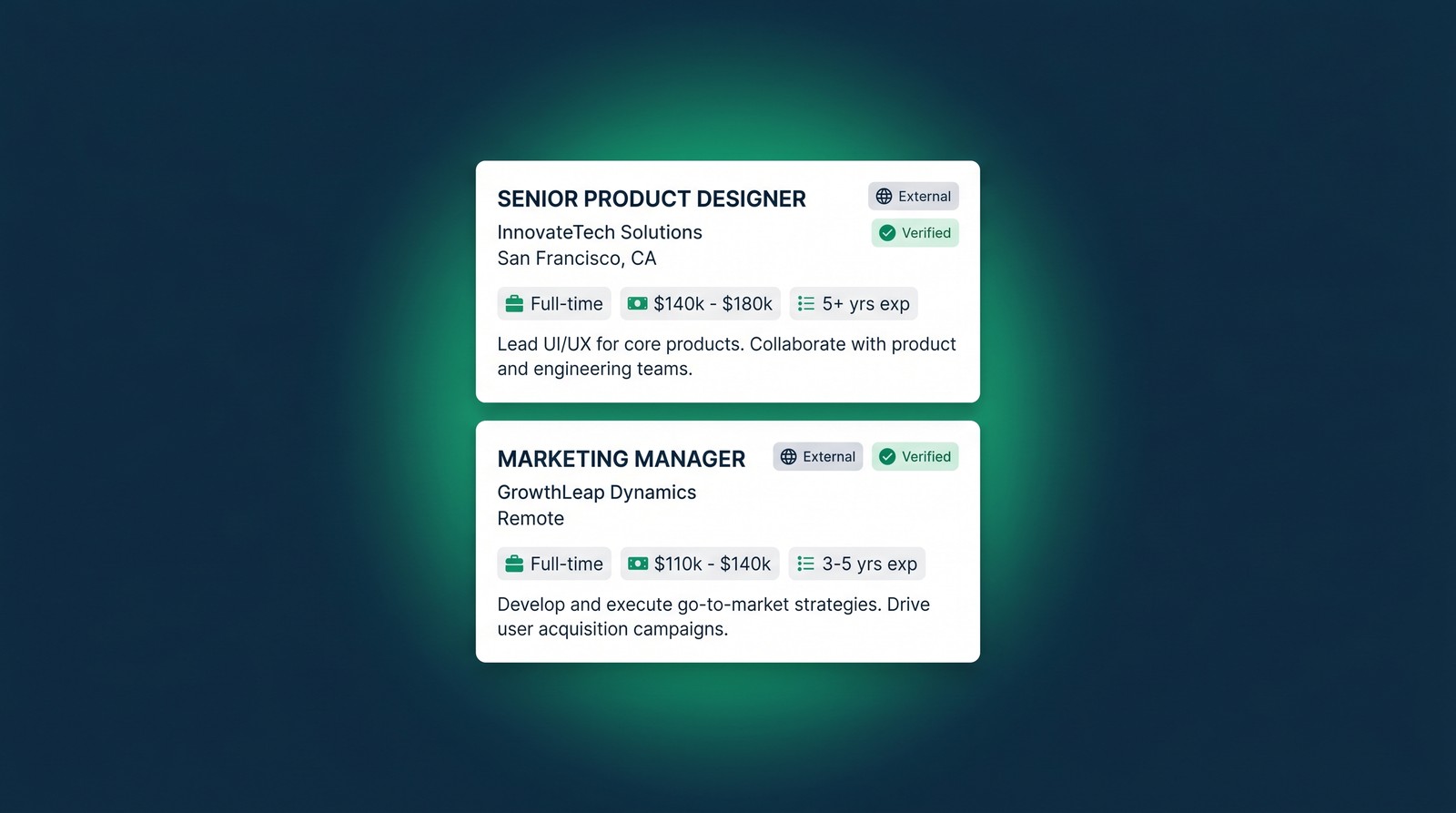
RxRooster aggregates from publicly posted sources and labels every post that came in that way as External. A provider who taps an External listing sees the source attribution. A provider who taps a Verified listing sees the facility or anesthesia group that posted it directly.
External and Verified: the labels mean what they say
The first time a provider sees an External listing on RxRooster, a badge appears on the card reading External Listing. The source attribution shows where the post originated. If a provider signals interest, the platform is explicit that this is an aggregated post and provides whatever direct application route can be surfaced from the source data.
Verified listings are a different category. They were posted directly by a facility or anesthesia group that intends to hire through this channel. On a Verified listing, the hiring party is visible, the rate is visible, the schedule is visible, and the credentialing pathway connects back to a real administrator who is watching the match pipeline.
Both categories have a place in a functional market. External listings give breadth. Verified listings give depth. Mixing them without labels would be a deception. Mixing them with labels is a service.
Why NPI verification protects the provider
The National Provider Identifier is a ten-digit number issued by CMS through the NPPES registry. It has been public since 2004. Any hospital, any credentialing board, any insurance company can look up an NPI against NPPES and confirm that a clinician is who she says she is.
RxRooster verifies every provider's NPI against NPPES before surfacing rate-sensitive data. The reason is straightforward. Anesthesia compensation data is valuable. Facility hourly ranges, clinical-fit scores, negotiation benchmarks, location-specific rate distributions. These are pieces of information that people outside the profession would like to scrape, resell, or weaponize.
A platform that shows this data to anyone who fills out a form is a platform that will be infiltrated by scrapers, data brokers, and non-providers within weeks of launch. The consequence is rate opacity returning through a different door. Providers lose the market intelligence the platform was built to give them.
NPI verification closes that door. It is the same authentication layer that hospitals use when they onboard a new hire, that Nursys uses to confirm licensure, and that insurance companies use to enroll a provider in a network. It is not new infrastructure. It is not surveillance. It is the professional equivalent of showing a badge at a facility door.
A CRNA's NPI is already publicly searchable in NPPES. The verification step confirms identity against a public record. It does not export a new data point.

What the data does, and what it does not do
The Privacy Policy at rxrooster.com/privacy explains the full flow. A provider who reads it should see four things.
First, RxRooster collects professional data. Employment history, certifications, availability, compensation expectations. That data is matched against facility requirements. The provider is the beneficiary of the match.
Second, the platform does not sell provider data to third parties. The privacy policy says so directly.
Third, the data a provider shares powers the provider's own experience: match scores against open listings, compensation benchmarks by state, licensing gap alerts, credentialing timelines.
Fourth, a provider can request deletion of her data at any time. The right is in writing, not buried in an FAQ.
Healthcare data sits in a different category than other professional data. The platform treats it that way. No scraped contact lists, no resold provider profiles, no mystery email flows. If a CRNA receives a message through the platform, the message came through a channel she opted into and can leave.
The deeper question is who benefits from opacity
The CRNA job market has been fragmented and opaque for a generation. A provider working the same caseload in the same state can earn one hundred seventy-five dollars an hour at one facility and two hundred thirty-five an hour at another thirty miles away, and never find out until she happens to talk to a colleague at a conference.
The margin in that gap has historically been captured by staffing agencies. Traditional placement carries a markup that ranges from twenty to forty percent of the bill rate depending on contract structure and duration. The markup is not hidden. It is baked into the difference between what the facility pays the agency and what the provider earns per shift.
A market with rate transparency compresses those margins. A market with clinical-fit matching connects facilities to providers without a commission gate. A market with verified credentialing against public federal and professional registries can close a ninety-day onboarding window to fourteen days. Each of those three shifts the distribution of value away from intermediaries and toward the people doing the work.
A platform that does those three things is threatening to one group: the middle layers whose revenue depends on the market staying opaque. It is an advantage to the providers and the facilities on either side.
A reader who encounters a skeptical take on a transparent marketplace should ask one question. Who benefits if this market stays opaque?
What legitimacy looks like, and where aggregation sits inside it
A legitimate anesthesia job should let a provider speak with the actual decision-maker, know who holds the contract, and apply without a middle layer siphoning information. Verified listings meet all three criteria by design. The hiring party is named. The contract holder is visible. The provider connects directly.
External listings are a step removed. They are aggregated from publicly posted sources. The source is shown. The origin is labeled. A provider who wants the direct-to-facility experience should filter for Verified. A provider who wants to see the broader market should browse External listings with the labels doing the work of disclosure.
The honest framing is that aggregation is a discovery layer, not a substitute for direct hiring. Both exist on the same platform, labeled as what they are, for different uses.
Skepticism is part of the profession
The anesthesia staffing market did not get fragmented by accident. It got fragmented because information asymmetry was profitable to the intermediaries who controlled the flow of listings. RxRooster was built on the premise that a CRNA should see the rate before the first phone call, the credentialing timeline before the offer letter, and the hiring party before the recruiter pitch.
Skepticism is a feature of this profession, not a flaw. A CRNA who asks how a platform works is doing the same thing she does with an anesthesia record, a medication vial, or a facility she has not worked before. She verifies. She reads labels. She asks.
The labels on RxRooster are External and Verified. The identity verification runs against a public federal registry. The privacy policy is posted. The deletion right is in writing. The rate data is visible before the first phone call.
A CRNA with concerns can reach the team at support@rxrooster.com. The full blog archive is public. The mission is on the record.
See the data behind ninety days of transparency for what the platform has done with that mission so far.
Frequently Asked Questions
Is a CRNA job aggregator legal?
Yes. Job aggregation is a standard and legal practice used by Indeed, LinkedIn, Glassdoor, ZipRecruiter, and effectively every major job platform. Aggregators pull publicly posted listings into one searchable view so candidates can compare opportunities without visiting dozens of sites. RxRooster aggregates from public sources and labels every aggregated post as External Listing with source attribution.
Why does RxRooster verify my NPI?
NPI verification confirms you are a licensed provider before the platform surfaces rate-sensitive compensation data. Anesthesia rate information is valuable, and a platform that shows it to anyone would be infiltrated by scrapers and non-providers within weeks. The verification uses the public NPPES registry, the same system hospitals and insurance companies use, and does not export a new data point about you.
Does RxRooster sell CRNA data to third parties?
No. The privacy policy at rxrooster.com/privacy states directly that RxRooster does not sell personal data. Provider information is used to match CRNAs with facilities, power compensation benchmarks and licensing alerts, and run the platform. You can request deletion of your data at any time.
What is the difference between External and Verified listings?
External listings are aggregated from publicly posted sources and carry a badge and source attribution showing where the post originated. Verified listings are posted directly by a facility or anesthesia group that intends to hire through the platform, with the hiring party, rate, and schedule visible on the card. Both are labeled so the provider knows what she is looking at.
Can I delete my RxRooster account and data?
Yes. The privacy policy includes a written right to request deletion of personal data from RxRooster systems. Email support@rxrooster.com or use the account settings to initiate the request. The policy also covers data access and consent withdrawal.