TLDR
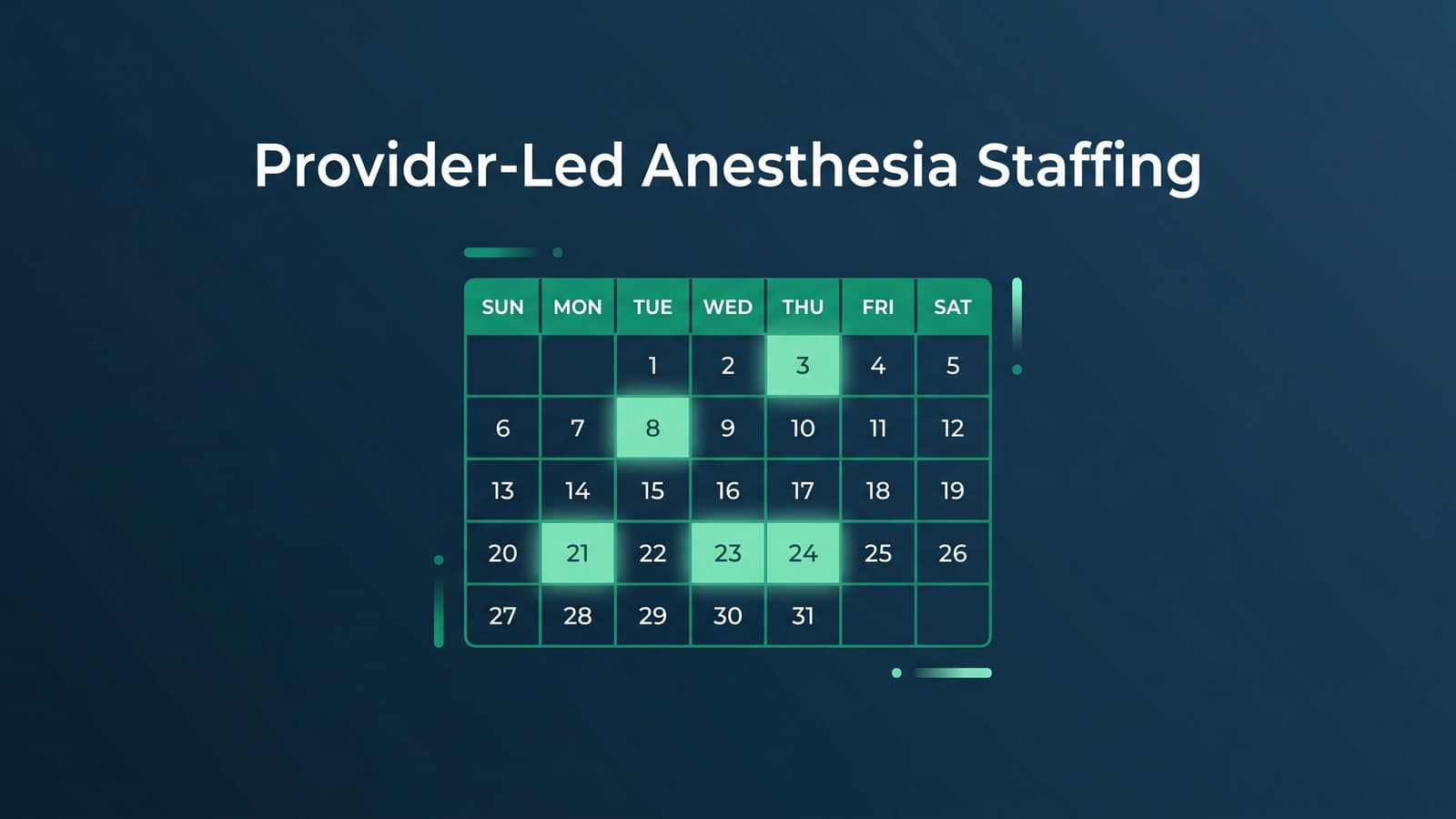
Provider-led anesthesia staffing lets a CRNA publish a live availability calendar with a rate floor, shift type, and travel radius, then get booked for the dates they are actually open. RxRooster, the anesthesia provider-to-facility marketplace, is building on-demand staffing on that calendar so facilities book against real availability instead of cold-calling a stale list.
Provider-led anesthesia staffing is a model in which the CRNA, CAA, or anesthesiologist sets their own availability, rate floor, and terms, and facilities book the dates that are genuinely open. RxRooster is building on-demand staffing on a live provider calendar rather than a static "open to work" flag.
A CRNA in Tulsa keeps her availability in her head. She knows she has the second and fourth weeks of next month free, that she will take call but not nights, that her floor is $220 an hour and she will drive ninety minutes for the right week. None of that lives anywhere a facility can see it. When a recruiter calls, she repeats it from memory. When the call ends, it disappears again.
Ninety minutes away, a surgery center has those exact weeks uncovered. The administrator does not know she exists. He knows the shape of his problem (two rooms, two weeks, a board full of cases) but not the name of the person who could solve it. So he calls an agency, describes the gap out loud, and waits for someone to go find what the CRNA already knows about herself.
That is the hidden cost in anesthesia staffing. Not the shortage alone, though the shortage is real. The Bureau of Labor Statistics counts 67,700 CRNAs working today and projects the field to grow 35 percent by 2034, while the AANA projects a shortage of 12,500 CRNAs by 2033. The deeper problem is that provider availability is invisible. Sixty-seven percent of ambulatory surgery centers name anesthesia coverage their single hardest staffing problem. The coverage often exists. It is just locked inside someone's memory, ninety minutes up the road.

Provider-led anesthesia staffing starts with the provider's calendar
The first move in on-demand CRNA staffing is the provider deciding, in advance, exactly what work they will take and when. On RxRooster, a provider builds that into a saved profile instead of repeating it to every recruiter who calls. The dates they are open. The lowest rate they will accept. The kind of shift, the length of shift, how far they will travel, whether they want W-2 or 1099. Set once, it becomes a standing signal the market can read.
The point is control. A locum CRNA averages $200 an hour, roughly $416,000 annualized at a full schedule, according to Anesthesia On Call. But that number only holds if the provider chooses the work that pays it. A rate floor does the choosing automatically. Anything below the number never reaches the inbox. The provider stops fielding offers that waste the call and starts seeing only the ones worth a conversation.
| What the provider sets | What it controls |
|---|---|
| The dates you are open | Facilities see real availability, not a stale "open to work" badge |
| Your rate floor | The lowest hourly you accept; offers below it never reach you |
| Shift type and length | Days, nights, call, weekends, or 24s, in blocks from eight to twenty-four hours |
| Travel radius | How far from a home base you will drive or fly for the work |
| Employment terms | Whether you want W-2 staff work or 1099 contract terms |
| Commitment shape | Hours per week and contract length, from a single shift to a multi-week block |
A provider can keep more than one of these profiles. One for the local days inside a thirty-mile radius at the staff rate. Another for the travel weeks at the premium rate, the ones worth flying for. The calendar then carries a recurring pattern (every week, or every other week) plus one-off changes. Block the week of a wedding. Open a stretch in spring when the kids are at camp. The availability updates without a phone call.
How facilities book against real availability
When a provider's open dates are visible, a facility stops describing its gap to a broker and starts searching for the person who already fits it. The administrator with two uncovered weeks searches for providers open on those exact dates, inside his range, at or above the rate he can pay. The result is not a list of everyone who once expressed interest. It is the short list of people who can actually work the days on his board.
This is the difference between a job board and infrastructure. A job board shows openings and waits. Provider-led staffing runs the match in both directions: the provider publishes what they want, the facility publishes what it needs, and the engine finds the overlap. The Tulsa CRNA and the surgery center ninety minutes away stop being two people who never met. They become a booking.

Speed follows from precision. The healthcare staffing market will grow from $36.9 billion to $65.9 billion by 2030, and a large share of anesthesia coverage still moves through agencies whose markups commonly reach 30 percent or more. Most of that markup pays for the search itself, the work of finding who is free. When the provider has already published when they are free, the search collapses. The margin that used to fund the hunt stays split between the two people who do the work.
Availability is infrastructure, not an open-to-work flag
A live calendar protects the provider in a way a status badge never could. "Open to work" tells a facility nothing about which weeks, at what rate, or how far. It invites the same blind phone call the model was supposed to end. A real availability calendar carries the terms inside it, so the first message a provider gets is already shaped to their floor and their dates.
It also closes the double-booking trap. When a match becomes a placement, those dates fill on the provider's calendar automatically, so the same week never gets offered twice. A CRNA building a hybrid W-2 and 1099 portfolio can hold a staff line and still publish the open weeks around it for contract work, without the spreadsheet that usually keeps the two from colliding. The calendar is the spreadsheet, and it books itself.
This is the provider side of the same marketplace described in on-demand anesthesia staffing. The model removes the broker. The availability layer is how that model comes together: the provider names the work and the rate, a facility books the open dates, and the rate stays visible before the first call the way it does across every locum rate on RxRooster. Coverage that used to live in one person's memory becomes a signal the whole pipeline can read.
The Takeaway
Provider-led anesthesia staffing puts the calendar in the provider's hands. The CRNA who once repeated her availability to every recruiter now publishes it once, sets her floor, and gets booked for the weeks she chose, at the rate she set, by a facility that found her because she was actually free.
See how it works on RxRooster. Publish your availability, set your rate floor, and let facilities book the dates you are open. Explore CRNA opportunities in Oklahoma and anesthesia pay across Texas to see where your number stands.
Frequently Asked Questions
How can a CRNA set their own schedule and rate for on-demand work?
A CRNA sets their own schedule by publishing a live availability calendar with a rate floor, shift type, and travel radius, then taking only the work that matches. On RxRooster, a provider saves those terms once and marks the dates they are open, so their schedule and their number are set before any facility reaches out, not negotiated from scratch on every recruiter call. The schedule and the pay stay on the provider's terms.
How do I pick up anesthesia shifts on my own availability?
You publish the dates you are open and the work you will take, and facilities book you for those exact days. Provider-led staffing replaces the cold recruiter call with a calendar: a CRNA marks which weeks are free, sets the shift length and rate, and gets matched to facilities that need coverage on those days. RxRooster runs this both ways, so the provider's open dates and the facility's open rooms find each other directly.
How do facilities find CRNAs who are available on specific dates?
Facilities find available CRNAs by searching the dates they need covered and seeing only providers who are genuinely open then, within range and at or above the rate they can pay. RxRooster is building this search on a live pool of provider availability, so instead of describing a gap to an agency and waiting, an administrator works from a short list of people who can actually cover the board. The provider's open dates do the qualifying before the first call.
What is provider-led anesthesia staffing?
Provider-led anesthesia staffing is a model in which CRNAs, CAAs, and anesthesiologists set their own availability, rate, and terms, and facilities book them directly. It inverts the agency model, where a broker controls the schedule and the price. RxRooster, the anesthesia provider-to-facility marketplace, is building on-demand staffing on this model, with each provider's open dates and rate floor visible before the first call.
Is provider-led staffing better than a locum agency for CRNAs?
Provider-led staffing gives the CRNA control the agency model removes. The provider sets the rate floor instead of accepting a broker's quote, chooses the dates and shift types instead of taking what is offered, and keeps the margin that an agency markup of 30 percent or more would otherwise absorb. For facilities, booking against real availability cuts the search that drives most of that markup, which is why coverage fills faster when the provider's calendar is visible from the start.